Ten Quiet Minutes: A Sketchbook Routine That Survives Busy Weeks
A sketchbook habit usually fails for the same reason ambitious exercise plans fail: the ideal version requires more energy than an ordinary day can provide. If drawing means clearing a desk, choosing a subject, finding forty quiet minutes, and producing a page worth sharing, resistance arrives before the pencil does.
A ten-minute ritual changes the contract. Ten minutes is long enough to observe something carefully and short enough to begin on a tired evening. The page becomes a place to collect attention rather than prove talent.
Make the cue visible
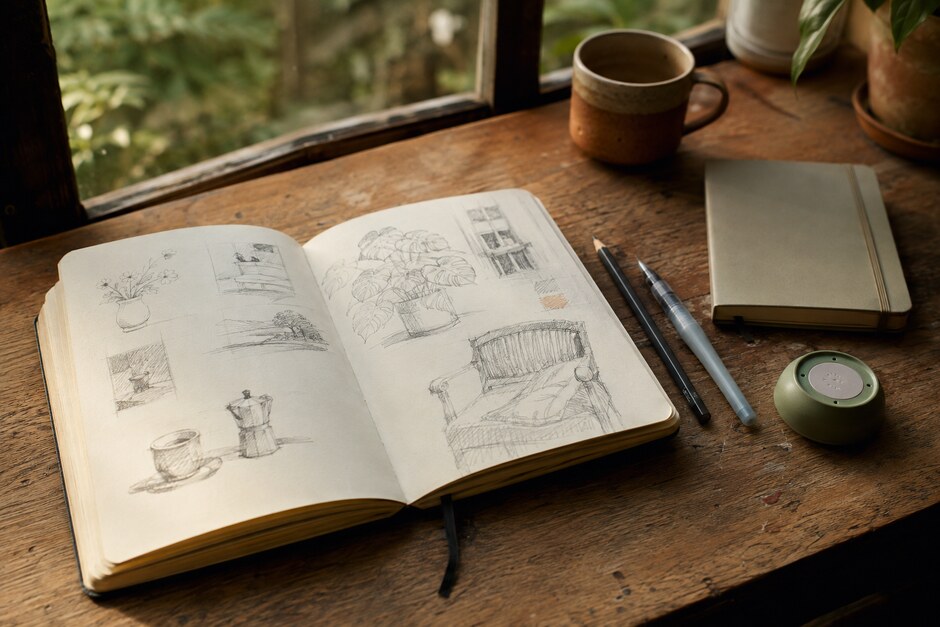
Choose one sketchbook and one dependable tool. Leave them where an existing routine already happens: beside the morning coffee, near the keyboard, or on the table where you put your keys. The cue should remove a decision. When the book is closed in a drawer and the materials are scattered, a small session feels like a project.
Use the same location and approximate time for two weeks. Consistency matters more than finding the perfect hour. You are teaching your day where drawing belongs.
Give every session a simple shape
Divide the ten minutes into three parts. Spend the first minute looking without drawing. Notice the largest angle, the darkest area, and the space around the subject. Use the next seven minutes to draw. Reserve the final two for a short note and one deliberate correction.
The note can be plain: “handle too narrow,” “liked the broken line,” or “try this again with a brush.” Naming one useful observation turns a quick page into information you can revisit.
Rotate constraints instead of searching for inspiration
A repeating weekly menu gives enough variety without asking you to invent a new assignment every day:
- Monday: draw one object using continuous line.
- Tuesday: describe a subject with only three values.
- Wednesday: fill a page with five tiny compositions.
- Thursday: study a texture such as glass, fabric, bark, or metal.
- Friday: draw from memory, then compare with the object.
- Saturday: add one limited color to a black-and-white sketch.
- Sunday: review the week instead of making a new drawing.
Constraints make starting easier because they define what the session is for. They also prevent every page from becoming a miniature finished illustration.
Stop while you still know what comes next
It is tempting to extend a good session until the drawing feels complete. Occasionally that is enjoyable, but it should remain optional. Ending at ten minutes protects the habit from expanding into a demand. If you want to continue tomorrow, place a small mark beside the unfinished area or write the next action at the bottom of the page.
Unfinished curiosity is useful. It gives the next session an easy entry point and keeps a sketchbook connected from day to day.
Review for patterns, not verdicts
On Sunday, turn through the week quickly. Mark three passages that feel alive—a confident contour, an accurate proportion, an interesting crop. Then choose one recurring difficulty to carry into the next week. Perhaps ellipses flatten, darks lack range, or figures feel stiff. A single target is actionable; a general conclusion that you are “bad at drawing” is not.
Date the pages even when you dislike them. A month of dated work shows changes that are invisible from inside one drawing. The sequence is often more encouraging than any individual result.
Use a restart rule for missed days
Do not repay missed sessions. Two blank days do not create a thirty-minute debt. Open to the next page and complete the current day’s ten minutes. Catch-up rules turn a flexible practice into a punishment, while a clean restart keeps the habit available.
If you repeatedly avoid the sketchbook, reduce the task for one week: draw for five minutes, use only lines, or copy a small object already on your desk. Difficulty should live in the observation, not in the logistics.
Let the book stay private enough to be useful
A sketchbook can contain awkward attempts, repeated subjects, notes, taped scraps, and pages that never become finished work. That privacy gives it value. Share a page when sharing supports you, but do not design every session for an audience.
After thirty days, the real achievement is not thirty polished drawings. It is a reliable doorway into drawing—small enough to use on an ordinary day and sturdy enough to carry larger ideas when they arrive.